

Which Repair Mechanism(S) Involve(S) The Removal Of A Single Nucleotide?
Deoxyribonucleic acid repair tin can be divided into a set up of mechanisms that identify and right damage in DNA molecules. There are two full general classes of DNA repair; the direct reversal of the chemical process generating the impairment and the replacement of damaged nucleotide bases.
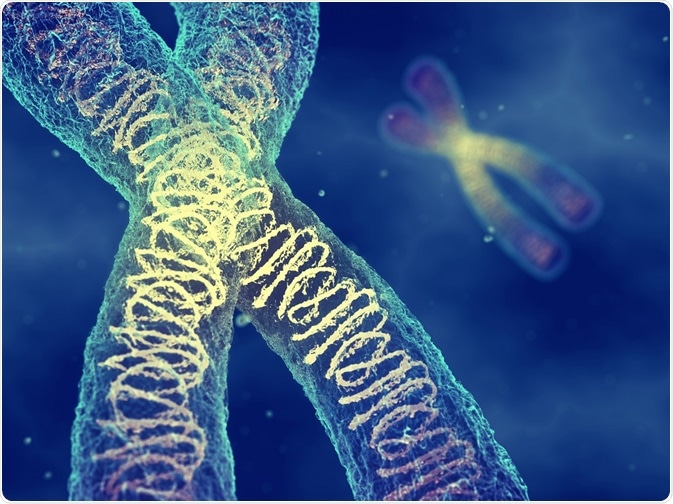
Credit: nobeastsofierce/Shutterstock.com
DNA encodes the prison cell genome and is therefore a permanent re-create of a structure necessary for the correct functioning of a cell. Changes to the structure of Dna can crusade mutations and genomic instability, leading to cancer. Damage to Dna is caused by the incorporation of incorrect nucleotide bases during Dna replication and the chemical changes caused by spontaneous mutation or exposure to environmental factors such as radiation.
The directly reversal DNA repair mechanism
Direct reversal of DNA damage is a mechanism of repair that does non crave a template and is applied to two principal types of damage. UV light induces the formation of pyrimidine dimers which can distort the DNA chain structure, blocking transcription beyond the area of damage.
Directly reversal through photoreactivation can changed this dimerization reaction by utilizing light free energy for the destruction of the aberrant covalent bond between adjacent pyrimidine bases. This blazon of photoreactivation does not occur in humans.
The damage acquired past alkylating agents reacting with Deoxyribonucleic acid tin can likewise be repaired through direct reversal. Methylation of guanine bases produces a change in the structure of Dna past forming a product that is gratis to thymine rather than cytosine. The protein methyl guanine methyl transferase (MGMT) can restore the original guanine by transferring the methylation product to its active site.
DNA repair by excision
Excision is the general mechanism by which repairs are fabricated when 1 of the double helix strands is damaged. The not-defective strand is used as a template with the damaged DNA on the other strand removed and replaced by the synthesis of new nucleotides. There are three types of excision repair:
- Base-excision repair.
- Nucleotide excision repair.
- Mismatch repair.
Base-excision repair involves the recognition and removal of a single damaged base. The mechanism requires a family unit of enzymes called glycosylases. The enzymes remove the damaged base forming an AP site which is repaired by AP endonuclease before the nucleotide gap in the DNA strand is filled by DNA polymerase.
Nucleotide excision repair is a widespread machinery for repairing damage to Deoxyribonucleic acid and recognizes multiple damaged bases. This mechanism is used to repair the formation of pyrimidine dimers from UV light within humans. The procedure involves the recognition of harm which is then cleaved on both sides past endonucleases before resynthesis past DNA polymerase.
The third excision mechanism is called mismatch repair and occurs when mismatched bases are incorporated into the Dna strand during replication and are not removed by proofreading DNA polymerase. In mismatch repair, the missed errors are after corrected by enzymes which recognize and excise the mismatched base to restore the original sequence.
DNA double strand break repair
The repair of harm to both DNA strands is particularly important in maintaining genomic integrity. At that place are two chief mechanisms for repairing double strand breaks: homologous recombination and classical nonhomologous terminate joining.
Homologous recombination involves the exchange of nucleotide sequences to repair damaged bases on both strands of Dna through the utilization of a sister chromatid. Classical nonhomologous terminate joining connects the break ends without a homologous template through the use of short Deoxyribonucleic acid sequences called microhomologies. The mechanism is prone to error but protects genome integrity from possible chromosomal translocations that can occur through homologous recombination.
Studies have too found that double strand breaks can exist repaired through culling mechanisms such as single-stranded annealing and alternative joining during certain conditions. These mechanisms are mutagenic and tin can lead to a loss in genetic information.
Single-stranded annealing provides stop joining between interspersed nucleotide repeats within the genome leading to one copy of the echo and the intervening sequence existence deleted in the process. Alternative joining has an undefined mechanism for repairing double strand breaks but is known to risk genomic integrity by joining end breaks on different chromosomes.
What happens when your Deoxyribonucleic acid is damaged? - Monica Menesini
Sources:
- Cooper M.M. 2000 The Cell: A Molecular Approach. 2nd edition. Sunderland (MA): Sinauer Associates: Dna Repair.
- Eker, A.P. et al. 2009. DNA repair in mammalian cells: Straight DNA impairment reversal: elegant solutions for nasty problems, Cellular and Molecular Life Sciences, 66, pp. 968-980.
- Fuss, J.O. & Cooper, P.Thou. 2006. DNA Repair: Dynamic Defenders against Cancer and Aging, PLOS, 4, e203.
- Ceccaldi, R. et al. 2016. Repair Pathway Choices and Consequences at the Double-Strand Break, Trends in Jail cell Biology, 26, pp. 52-64.
Farther Reading
- All DNA Content
- What is Dna?
- Deoxyribonucleic acid Properties
- DNA Chemical Modifications
- DNA Biological Functions

Source: https://www.news-medical.net/life-sciences/Mechanisms-of-DNA-Repair.aspx
Posted by: williamstheive.blogspot.com
0 Response to "Which Repair Mechanism(S) Involve(S) The Removal Of A Single Nucleotide?"
Post a Comment