

How To Repair A Split In Native American Flute
How to Tie the Block on a Native American Flute
This page describes the how to tie (or re-tie) the cake on a Native American flute. The bones information is provided, as well every bit detailed information on special cases and alternate knots that tin can be used.
The Basics
On most Native American flutes, the block is removable – held in place on the nest area only by a strap.
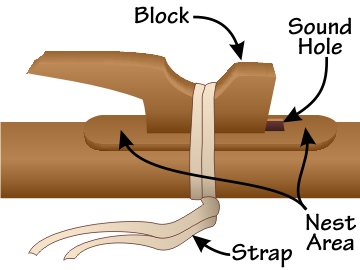 |
| Nest Area of a Native American flute — Outside |

Some flutes use a spacer plate between the lesser of the block and the nest area:
 |
| Spacer plate between the nest |
Although the strap is typically made of leather, information technology tin be almost annihilation. Flute makers oftentimes utilise a rubber band to chop-chop ready the block onto the nest area.
Well-nigh blocks are designed so that they tin can be secured to the nest expanse past wrapping the strap over the center of the block. However, some makers have alternate arrangements for the strap. This tulipwood flute by Richard Maynard of Laughing Crow Flutes demonstrates a design where the strap wraps around ii parts of the flute. In my feel, this design gives the cake more than stability from sliding lengthwise along the body of the flute:
 |
| Block design used by Richard Maynard |
Other flute makers add holes into the block through which ane or more straps are threaded. This is an example of a design using iii separate straps by Leonard McGann of Lone Crow Flutes:
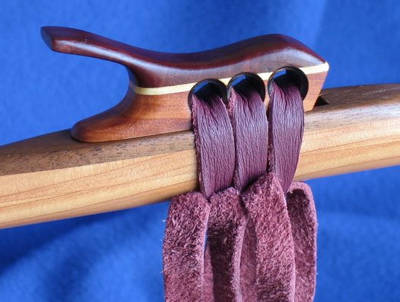 |
| Block pattern used past Leonard McGann |
The block serves many purposes:
- Information technology forms the roof of the flue, routing your airstream from the go out hole of the dull air sleeping accommodation to the sound hole. The airstream then hits the splitting edge at the far end of the sound hole, which sets up the vibration that causes the flute to sound.
- It also provides a degree of protection for the sound pigsty and the delicate splitting edge.
 |
| Nest area of a Native American flute — |
Removing the Cake
If you untie the strap, the block should be piece of cake to remove. If it is not, in that location are several possibilities:
- The cake may take been tied onto the flute for a very long time
- The flute may accept been designed with a fixed block – glued into position. This is the case with a (very) few gimmicky flute makers – in particular, those making flutes in the Micmac tradition.
Yous might be amazed at the number of players who have never removed the cake from their flute. Novice players are typically unaware of the problems and can be fearful of not being able to restore the block to the nest. This situation is so common that, in flute workshops, we always go through the practise of removing and replacing the cake.
Some good reasons to remove the block:
- If you play for more than than a (very) few minutes, you can get significant moisture inside the SAC. This moisture can accept a long time to dry out, especially if the breath hole is small. That tin requite time for microbes to gain a foothold. By removing the block, yous open the SAC Exit Pigsty and the Wearisome Air Chamber will dry much faster. However, yous should never use heat or drying equipment (such every bit a pilus dryer)!
- It is possible over time for the block to bind to the nest. Removing it can be difficult or impossible without damaging the block or the nest.
- Flutes without a block have a much lower profile and tin be transported more than easily in some cases.
Replacing the Block
Hither are basic instructions for tying the block onto the flute, using an overhand knot (also called a "simple noose", a "thumb knot", and a "reef knot"). This is the kind of knot that you utilize as the first pace when tying shoelaces. The overhand knot is listed as knot #514 in the ABoK ([Ashley-CW 1944]).
- Position the block (and maybe the spacer plate as well), in an approximate position on the nest area. Information technology does not have to exist precisely positioned.
- Drape the strap over the center of the block and wrap it one time, and so that ii turns of the strap are on the height of the block and the loose ends of the strap hang underneath the flute. Adjust the strap so that the loose ends of the strap are approximately of equal length.
- Holding the 2 loose ends of the strap, rotate the body of the flute so that the cake faces down (being conscientious non to driblet the block!)
- Tie the 2 complimentary ends of the strap with one overhand knot, equally shown:
Here is a diagram of how it is tied. The green wrap on the right shows the total wrap from pace ii higher up. The green and regal segments to the left are the two free ends of the same strap – they are colored to make information technology easier to follow how the knot is tied:

Finally, sure-fire down the knot reasonably tightly, and so gently slide the cake into information technology'due south best position. The strap should be tight enough to proceed the block stable when you are playing information technology. However, the block will probably demand to be adjusted later on taking information technology out of a flute case.
Annotation: Yous should never drag the block any significant distance along the flute or try to slide the cake and the strap together. If you need a major adjustment in the position of the cake, remove the strap and outset over. The specific shape of the bottom of the block is critical to the audio that the flute creates, and any damage to the bottom of the block will need to exist repaired by the maker of the flute.
Positioning the Block
A proficient kickoff approximation is to position the block so, as you look downward at the audio hole, the face of the block is on the edge of the sound pigsty – correct on the edge, but not covering up whatever of the audio hole. From there, finding the best position for the block is a deep listening exercise.
The pictures above show three positions for the block. The relation of the front border of the block to the back edge of the sound hole is the important chemical element. These are somewhat farthermost positions — probably the limits of how far back and frontwards y'all would place the block:
- In the leftmost picture, the front edge of the block is far back from the sound hole. You can see the bottom of the flue. This is likely to produce a relatively blatant sound.
- In the eye picture, the front end edge of the block is shut to and slightly backside the back of the sound. This is likely to be close to the sweet spot for most Native American flutes.
- In the rightmost flick, the block is positioned very far forward. The flute is likely to audio "sparse" and will likewise tend to overblow more easily.
With the strap just loose enough to permit some movement in the block, play a long tone and listen to the audio. It helps to play facing a wall, with the foot of the flute about touching the wall (utilise caution – hitting the wall or any solid object with the foot of the flute can knock your teeth out!). You could also rig upwards a microphone and earphone setup to hear the sound of the flute more clearly.
Now play a long tone with the upper holes holes, leaving your other hand free to arrange the block. Slide the block in tiny increments and see if you locate the sweet spot of the sound.
If your flute has a spacer plate, you will exist experimenting with the position of both the spacer plate and the block.
Moving the block and/or spacer plate will affect many compnents of the sound: pitch (typically flatter as you motility the block towards to human foot of the flute), breathiness, timbre. Moving the cake towards the foot of the flute will also tend to make the flute leap into the 2nd register on the lowest note.
Marking the Block and Spacer Plate Position
Some players, peculiarly if they perform or if they have problems finding a good position for the block and spacer plate, marker a "starting bespeak" position for the cake. This allows them to gear up the block position visually.
Yous can do this with a fine-indicate permanent marking: In one case you have a skilful position, place a straightedge perpendicular to the body of the flute. In an inconspicuous place, draw a small line on the block, the body of the flute, and the spacer place, if nowadays.
Material used for the Strap
Although the strap is typically made of leather, it can be almost anything. Flute makers often use a rubber band to rapidly fix the block onto the nest area.
Barry Higgins of White Crow Flutes describes an alternative for performers, and as well provides recommendations on selecting leather for the strap (personal advice, May 12, 2022):
The showtime time I met Jeff Brawl he was playing a concert in the White Mountains in New Hampshire. Information technology was an evening concert, belatedly summer, under a tent, and information technology was raining. These are perfect weather for "wetting out", but Jeff handled these conditions very well. The reason was, he was using black elastic pilus ties (scrunchies) for bird ties. These rubberband ties allowed him to move the bird away with out untying the bird, wipe the flue dry, and position it dorsum again in less than a 4 beat out rest, yet held the bird in position and contact with the flute body.
If you have more one flute you may take noticed there can be a difference in the leathers generally used to necktie the bird to the flute. The best leather past far is tanned Deer hide. The reward is that the leather is softer, thinner, and has an wonderful rubberband quality to it. Y'all can experience information technology stretch when tying. Elk has similar backdrop to deer but is most oft thicker than deer hide and slightly less elastic and so the deer. Tanned Cow hide is thicker and stiffer than elk and no rubberband qualities. Cow hide is often split (thinned) to make it more supple just does not make information technology more rubberband. The non-elastic qualities requite the leather strength but less holding strength in the tie-off if a course of knot is not used. The least effective necktie is ane fabricated of raw hide laces, the type used for boots. Although small in size information technology is very potent and hard and requires a knot to concur. This type of leather can fifty-fifty cause indentations to grade on very soft forest like cedar, pino, and redwood. I suggest replacing ties like this as soon as possible. Pig skin, lamb, sheep, or goat are mostly too thin to be constructive tie material and intermission more hands. Always use intendance with any tie, when tightening, that have been cut thin, or in multiple strands. If you have a multi-strand strap, grasp the strands together when tying them off.
Other Knots
While the vast majority of players employ the overhand knot, you tin utilise many other knots to secure the strap. Each has information technology's pros and cons.
Shoelace Knot
For added security, you can build on the bones overhand knot and create a shoelace knot. This know, also called the bow knot, is knot #1212 in the ABoK ([Ashley-CW 1944]).
Here is an example of how Butch Hall of Butch Hall Flutes ties his flutes. Notice that Butch uses v wraps around the block and the flute, and completes the wrap with a shoelace knot:
 |
| Tying style used by Butch Hall |
In addition, Butch uses an unusual and decorative "10-crossover" style on the top of the block:
 |
| Tying style used by Butch Hall |
Clove Hitch
The clove hitch appears in this image of a tied flute, from [Gage 2001]:
The clove hitch is listed equally knot #1176 in the ABoK ([Ashley-CW 1944]). Here's a sequence of pictures showing how to tie a clove hitch:
 |
| Tying a rolling hitch. Photos courtesy of David J. Fred |
Rolling Hitch
The rolling hitch is listed as knot #1734 in the ABoK ([Ashley-CW 1944]). Here's a sequence of pictures showing how to necktie a rolling hitch:
 |
| Tying a rolling hitch. Photos courtesy of David J. Fred |
Constrictor Knot
Constrictor knots are somewhat more complex that the knots shown then far, but they have some favorible backdrop in terms of security and adjustability. We look at iii versions of constrictor knots on this page:

Here's a sequence of pictures showing how to tie a constrictor knot:
 |
| Tying a constrictor knot. Photos courtesy of David J. Fred |
Double Constrictor Knot
Here's a sequence of pictures showing how to tie a double constrictor knot:
 |
| Tying a double constrictor knot. Photos courtesy of David J. Fred |
Slipped Constrictor Knot
Here's a sequence of pictures showing how to tie a slipped constrictor knot:
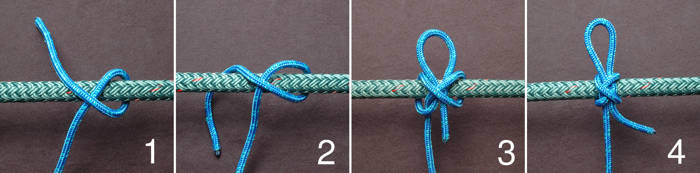 |
| Tying a slipped constrictor knot. Photos courtesy of David J. Fred |



Source: https://flutopedia.com/tie_block.htm
Posted by: williamstheive.blogspot.com
0 Response to "How To Repair A Split In Native American Flute"
Post a Comment